SUMELA MONASTERY LADY OF MOUNTAIN
With its multilayered structure extending from antiquity to the present day, if Trabzon is a jewel, its brightest gem is the Sümela Monastery.
2/7/20263 min read
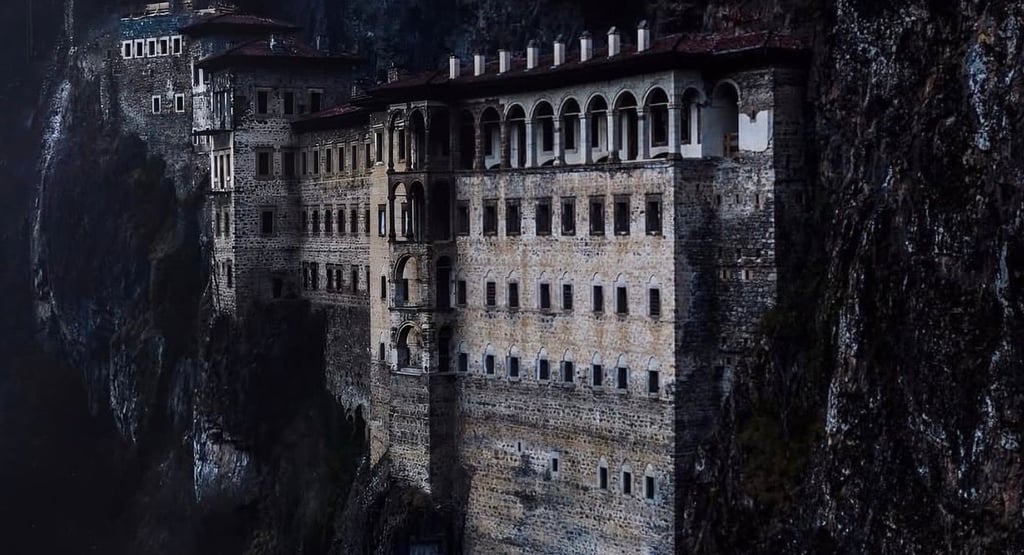
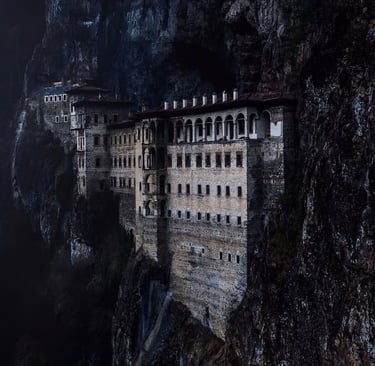
With its multilayered structure extending from antiquity to the present day, if Trabzon is a jewel, its brightest gem is the Sumela Monastery. From KARLİKA’s cultural perspective, it stands as one of the most important heritage sites that must be articulated through a careful and responsible language. Because cultural heritage is not merely what is visible to the eye; it is a balanced relationship established between historical continuity, spatial awareness, and geography.
Located in the Maçka district of Trabzon and carved into the steep cliffs overlooking the Altındere Valley, this structure is not merely a monastery. For centuries, it has been a symbol of faith, silence, and resilience. Its architecture does not challenge nature; on the contrary, it exists in harmony with it. It is not a secret hidden among the mountains, but a memory carried by them. Bearing its strength quietly and shaping its elegance not against nature but together with it, the monastery represents a delicate balance established within a harsh geography.
Its story is among the rare narratives where legend and history are deeply intertwined. According to tradition, guided by a sacred icon of the Virgin Mary, the monastery was placed at the heart of the mountain and functioned for centuries as a pilgrimage route, a place of seclusion, and a sacred refuge. Left unprotected for much of the twentieth century, the structure suffered significant damage and loss of artifacts during this period. Although many of the elements visible today have been restored, the monastery still carries the traces of its past. It is a site of memory that has reached the present day by passing through multiple historical periods. It speaks of a faith preserved within the mountains, a patience untouched by time, and an existence sustained in silence.
One of the aspects that makes Sümela particularly significant for Karlika is its ability to survive through different political and cultural eras over the centuries. Beginning as a monastery in the Byzantine period, it was placed under protection during the Ottoman era and reinterpreted as cultural heritage in the Republican period. This continuity removes Sümela from being the product of a single era and transforms it into a multilayered site of memory. The structure is one of the most concentrated points of Trabzon’s cultural identity. It is not merely a touristic destination, but a tangible expression of the relationship established over centuries between geography, belief, and human labor.
From the perspective of KARLİKA’s commitment to a qualified cultural narrative, the monastery is not a rapidly consumed visual symbol but a memory space that must be read, understood, and protected. It is not a frozen artistic site, but a narrative field that transforms together with time. Sümela Monastery is less a structure than a readable cultural landscape. The rock-carved spaces, water channels, living quarters, and places of worship demonstrate that Sümela was not only a religious structure but also a long-term living system. This system represents a conscious architectural and cultural strategy developed in response to the challenges imposed by its geography.
For this reason, the expression “If Trabzon is a jewel, Sümela is its brightest gem” is not merely an aesthetic metaphor but a statement defining cultural density. Because this brilliance does not arise from spectacle, but from meaning preserved over centuries. For KARLİKA , the essential task is to carry this meaning into the future without diminishing it.


Karadeniz Turizmi Lider Kadınlar Derneği - Kurucu Üye
Asiye BİRİNCİ
Adres
Cumhuriyet Mah. Muhittin sok. Cumhuriyet İş merkezi no:3 iç kapı no: 22 Ortahisar Trabzon
İletişim
+90 850 346 75 61
info@karlika.com.tr